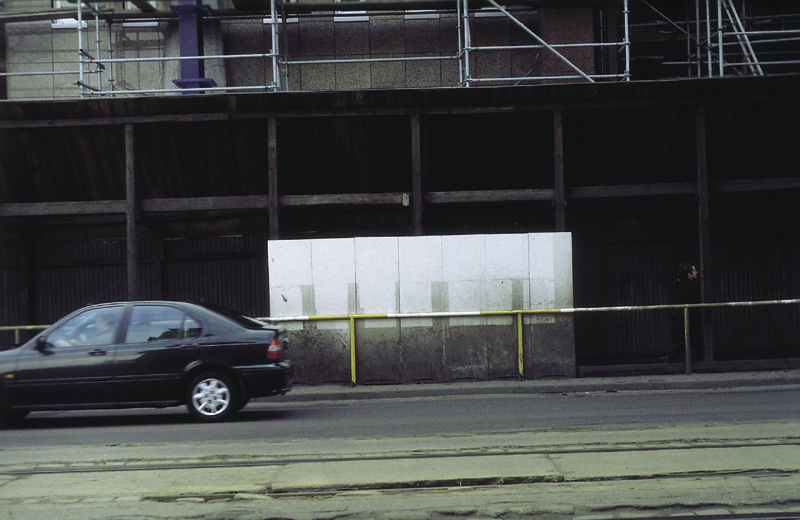
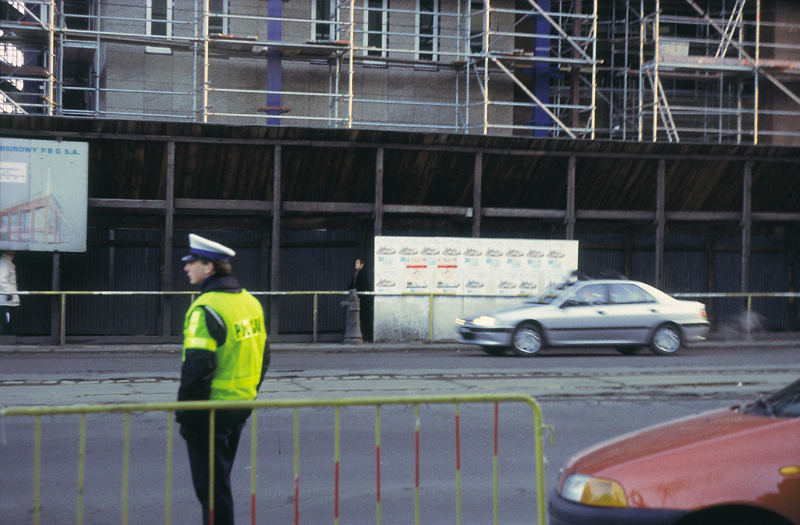


„O Piotrze C. Kowalskim, który w 1998 roku ustawił białe blejtramy na chodniku ulicy Głogowskiej w Poznaniu, tuż przy jezdni i oddzielającej ją od chodnika barierce można na początek powiedzieć, że podobnie jak Białoszewski „ustawił to na drobiazg”. (…) Eksperyment Kowalskiego zakładał, przeciwnie niż przeżycie miasta Białoszewskiego, zachowanie śladu – obrazu. Pacyny błota rozpryskiwanego przez przejeżdżające Głogowską samochody, które pokryły dolna część blejtramu i kurz miejski miały pozostać, by przeniesione w nową przestrzeń galerii uobecniać w niej miasto. „Brud” językowy z opowiadań Białoszewskiego znalazł swój odpowiednik w zabrudzonej przez rytm miejskiego ruchu ulicznego blejtramie. Neutralny kod językowy jest dla pisarza w przybliżeniu tym samym, czym dla malarza zagruntowany, biały blejtram. Miasto wtłacza w nie swoje rytmy, rysując wyraźny, błotnisty kardiogram. Rzecz najważniejsza pojawia się wszakże dopiero w środkowej i górnej części malowanego przez miasto obrazu. Kowalskiemu, jak prawdziwemu łowcy śladów, udało się uchwycić znaki pozostawione przez mieszkańców miasta: krople farby pozostawione przez malarza barierki, przy której blejtram został ustawiony, ślady po naklejonych i zerwanych przez autora plakatach. Wszystkie razem w sposób nieodparty prezentują nam sylwetę miasta przypominającą prace panoramistów – autoportret miasta, zapis jego zróżnicowanych rytmów. Zrealizowany zgodnie z rytmem toczącego się w nim życia, z materii, w której to życie się realizuje. Tym, co łączy eksperymenty poety i malarza z przestrzenią miejską okazuje się nie tylko dążenie do jej bezpośredniego uobecnienia się w materii dźwiękowej czy wizualnej, którymi się posługują. Myślę, że najważniejsze staje się dążenie do afirmacji miasta takim, jakim jest, miasta uwolnionego od wszelkich utopii. Skoro sobie uświadomimy, że głosy, ślady i ruch nie są radykalnie różnymi bytami, ponieważ nimi wszystkimi kieruje miejska rytmika, pozostaje tylko – zdają się mówić artyści – zwrócić się do samego miasta, by zapisało w dostępnych nam kodach, przefiltrowany przez ludzkie ciało i umysł.”
Ewa Rewers (2000)
______
„Regarding Piotr C. Kowalski, who in 1998 set up white canvases on the sidewalk of Głogowska Street in Poznań, right next to the roadway and the railing separating it from the pavement, one might say at the outset that, much like Białoszewski, he „tuned it to the details.” (…) Contrary to Białoszewski’s experience of the city, Kowalski’s experiment aimed to preserve a trace—an image. The clumps of mud splashed by cars driving down Głogowska, which covered the lower part of the canvas, and the urban dust were meant to remain, so that when transferred into the new space of a gallery, they would render the city present within it. The linguistic „dirt” of Białoszewski’s stories found its counterpart in the canvas soiled by the rhythm of urban street traffic. For the writer, a neutral linguistic code is roughly what a primed,white canvas is for the painter. The city forces its rhythms upon them, drawing a distinct, muddy cardiogram.
The most essential aspect, however, emerges in the middle and upper sections of the painting painted by the city.Kowalski, like a true tracker of traces, managed to capture the marks left behind by the city’s inhabitants: drops of paint left by the worker painting the railing against which the canvas was placed, and traces of posters pasted on and subsequently torn off by the author. Taken together, they irresistibly present us with a silhouette of the city reminiscent of the works of panoramists—a self-portrait of the city, a record of its diverse rhythms. It is realized in accordance with the rhythm of life unfolding within it, crafted from the very matter in which that life takes shape.
What connects the experiments of the poet and the painter with urban space turns out to be not only the pursuit of its direct presence within the sound or visual medium they employ. Crucially, I believe, it is the striving toward an affirmation of the city just as it is—a city liberated from all utopias. Once we realize that voices, traces, and movement are not radically different entities, as all of them are driven by the rhythms of the city, all that remains—the artists seem to say—is to turn to the city itself, so that it may record itself in the codes available to us, filtered through the human body and mind.”
Ewa Rewers (2000)